Problem
When schedules change, one person quietly absorbs the extra work, and asking for help sounds like an accusation.
Case studyRoomie · iOS & AndroidKathmandu Valley
Designing a household app that makes fairness visible, so nobody has to be the one who asks.
Scroll to step inside

00 — The brief
Roommates keep things fair with memory, WhatsApp and a chart on the fridge. When schedules change, one person quietly takes on the extra work, and asking for help sounds like an accusation.
Problem
When schedules change, one person quietly absorbs the extra work, and asking for help sounds like an accusation.
Solution
Roomie weights chores by effort, keeps heavy tasks off your busy days, turns missed chores into a pool anyone can claim, and sends the reminder itself.
Impact
A focused V1 of 27 hi-fi screens covering onboarding, chores, pantry and settings. Money and AI were cut to Phase 2 on purpose. Not yet tested: the plan is below.
It's usually a WhatsApp group, a verbal agreement and whoever notices the overflowing bin first. Roomie is for people who share a flat: students, young professionals and friends splitting rent in Kathmandu, Lalitpur and Bhaktapur.
Business goal
Freemium. Core coordination (chores, grocery list, reminders) is free forever. A household subscription, Roomie Plus, unlocks smarter automation later. Growth comes through invitations: every household that signs up brings two or three more users.
Constraints
Chapter one
How do households divide chores today, where does it break, and what would make people trust an app with something this personal?
Methods
competitor apps audited, across three rings
app-store ratings behind the four apps whose reviews I coded*
problem chains traced to a root cause with 5 Whys
* Ratings as recorded in my FigJam audit (Sweepy, Tody, Nipto, Settle Up). To be re-verified against the stores before publishing.
Competitive landscape
Four direct competitors, two indirect. The third ring was the real one: the habits. A group chat costs nothing and everyone already uses it.
What I found
Flatastic already combines chores, shopping and expenses. "All-in-one" isn't a differentiator.
Most answer what, who, when. None answer why this is fair or what should change.
Taking out the trash takes two minutes. A bathroom deep-clean takes forty-five. Counting tasks treats them the same.
Sweepy reviewers describe relief from not having to think about cleaning, not from cleaning less.
Tody reviewers ask for the plan to bend when they travel or get sick.
Nipto reviewers want control over the rules.
In Settle Up's reviews, trust comes from seeing the breakdown, not just the total.
Placeholder · verbatim review lines
2–3 short App Store review lines from Sweepy, Tody or Settle Up go here, attributed as "App Store review, Sweepy, 2026". Each under 20 words, verified against the store before publishing.
→ Decision
Don't position Roomie as chores + expenses + groceries. Position it as a neutral third party that carries the mental and social load.
Chapter two
What is actually broken, and for whom?
Insight 01 · Illustrated
Roommate A takes out the trash three times. Roommate B deep-cleans the bathroom once.
This is how most chore apps keep score: one task, one point.
3 × 2 min = 6 min, against 1 × 45 min. Counting tasks treats them the same.
So a fair system has to weigh tasks, not count them. That became the first rule of Roomie.
Click a chore to hand it to the other roommate, or drag it across. Then switch how fairness is measured.
Times from my research: trash ≈ 2 min, bathroom deep-clean ≈ 45 min.
Affinity mapping · five themes
One person notices everything and ends up doing it.
Asking for Rs. 150 back costs more socially than it's worth.
Nobody knows what's shared, what's personal, or what's already bought.
Exams, late shifts and travel break fixed rotas.
Coordination lives in memory and a chat that scrolls away.
As-is chore flow
A grocery run runs the same loop
Four insights
A fair system has to weigh tasks.
Planning, assigning and following up is invisible work.
The 5 Whys ended at the same place every time: there is no neutral intermediary. Hypothesis · not yet validated
"Why me, why this week" has to be answerable.
Proto-personas · assumptions to validate, not research findings
Persona A
Software engineer · Kathmandu
Unpredictable hours. He doesn't want to become "the default apartment manager".
Persona B
Banker · Pokhara
He notices every unfinished chore and ends up doing it himself rather than asking twice.
Problem statement
Roommates struggle to manage shared chores and groceries fairly because they rely on memory, scattered chats and manual coordination. As schedules change, nobody is clearly responsible for what, which creates mental load, awkward conversations and repeated friction.
How might we
Success criteria · targets, not results
to set up a new household
sentence to explain any assignment: "Heavy task moved off your busy Wednesday"
person-to-person reminders for tracked chores
test participants who describe a nudge as nagging or shaming
Chapter three
Go wide, then find the one bet worth making.
Going wide · Crazy 8s against five HMW themes
V1Phase 2Killed 13 of ~25 ideas shown. Filtered with an impact/effort matrix, then RICE.
What I killed, and why
Competing for points turns housemates into rivals, against the "don't rank people" signal in the research.
Rent discounts for doing someone's chore put a price on favours. That's exactly the tension I wanted to remove.
A huge legal and engineering lift. Once people know what they owe, they can scan a QR in the wallet they already use.
It solves a problem nobody had. The pain was coordination, not cooking.
The big bet
One system that answers all four insights.
Every chore is Light, Medium or Heavy. Rotation balances total effort, not task count.
Everyone marks their busy days, and heavy tasks never land on them.
Missed chores move to a pool anyone can claim, so nobody has to chase anyone.
Nudges come from Roomie, in a tone each person chooses.
The hardest trade-off
My first MVP had six features, including The Rolling Tab: a background ledger that settles small expenses monthly.
01
Splitwise and eSewa are good enough. The chore half is where nothing works.
02
Financial features only earn trust with complete, explainable breakdowns. A half-built ledger costs more trust than it earns.
03
V1's rotation is rule-based: effort points + busy days. Rules are explainable by default, the trust foundation AI needs later.
V1 · ship
Phase 2 · later
Chapter four
What does fair look like on a screen?
tabs: Home, Chores, Pantry, Profile. With Expenses out, every tab earns its place.
screens in the inventory, mapped with the flow logic before drawing anything
hi-fi screens designed for the core paths
Low-fi first
Everything so far was thinking.
Here's the home it built.
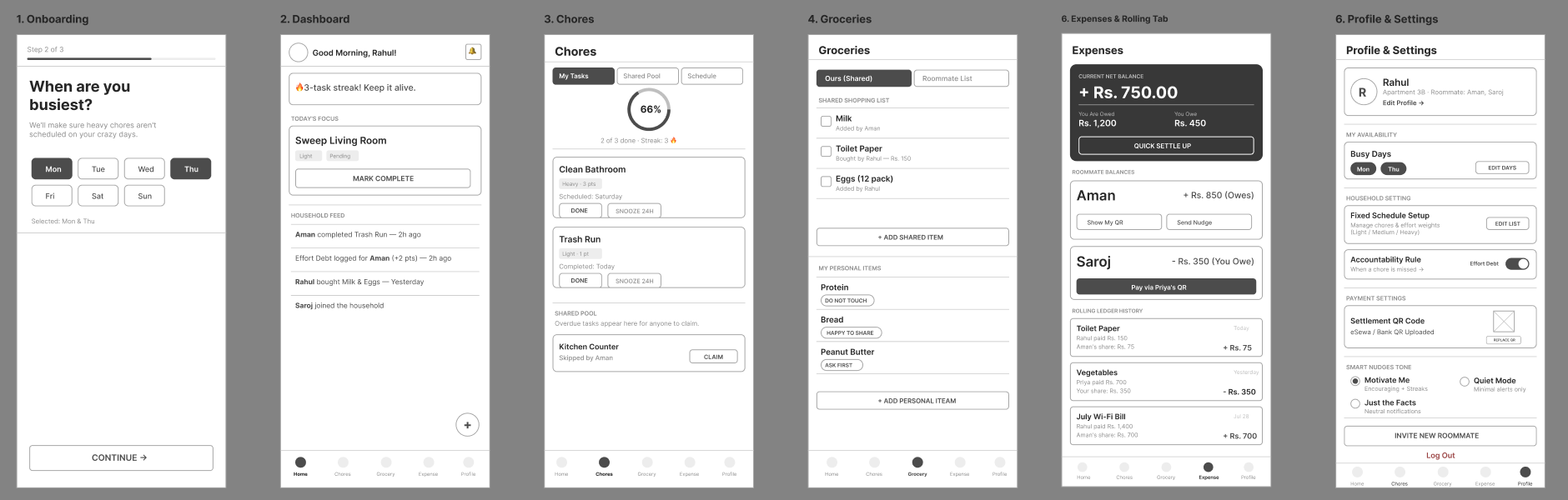
27 hi-fi screens · 6 flows · 4 tabs
Key screens · insight → decision 01 / 08
Insight If an app needs constant input, it becomes another chore.
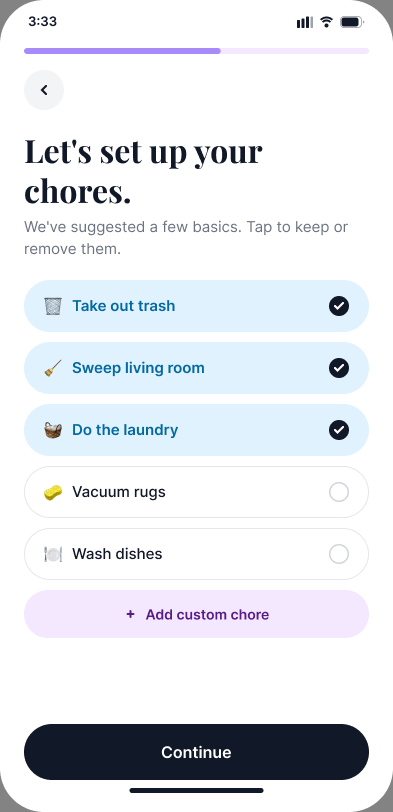
Five common chores are suggested and the basics come pre-selected; tap to keep or remove. Busy days on a single screen, a six-character code to invite. The progress bar keeps it honest.
Insight Fair isn't equal.
Adding a chore asks for an effort level (Light, Medium or Heavy) before anything else. Every task card carries its chip, so the balance is visible at a glance.
Insight Households aren't static.
One promise, in plain words: "We won't assign you heavy tasks on these days."
Insight Reminders between friends read as criticism.
A missed chore doesn't ping the person who missed it. It moves to a list anyone can claim. The list shows what's undone, not who dropped it.
Insight Nobody wants to be compared.
"Wonderful job. +1 day streak." Celebration moments thank people without comparing them. The sprout grows with the household's streak.
Insight Grocery conflicts are about unspoken rules.
Shared, My items, Roommates. Personal items carry a rule: Do not touch or Ask first. A restock request becomes a claimable chore, so groceries plug into the chore system instead of building a second one.
Insight Nobody wants a game forced on them.
Each person picks a nudge style: Motivate me (streaks, emoji, warmth) or Just the facts (quiet, text only).
Insight There is no neutral intermediary. So build one.
The lock screen does the reminding, in the voice of a flatmate who's on your side: "Gentle Nudge: The bathroom is waiting for a quick wipe down!"
Visual language
Display · Playfair Display
Aa
Hello, Rahul.
Text · Inter
A serif for warmth, a grotesque for clarity.
One pastel per roommate
Ownership reads without names.
Effort chips
The single most important component in the system.
Tone of voice is a UX decision
Every nudge written to sound like a flatmate who's on your side.
Final screens
Onboarding 8 · Home 1 · Chore Hub 3 · Groceries 9 · Profile & Settings 5 · Lock screen 1
Chapter five
How would I know I'm right?
Honest status Roomie hasn't been tested with users yet. This is the plan, not a result.
Round 1 · moderated usability test
5–6 people living with roommates in the Kathmandu Valley, ideally two full households. 30 minutes each on the Figma prototype.
The riskiest assumption
The research warns against ranking people, but V1 uses streaks and gives heavier loads to people who miss tasks. I'd show both nudge styles and the effort-debt state and ask one question:
"How would you feel if your roommate saw this?"
Decision rule If more than 1 in 5 participants says "judged", streaks become opt-in and effort debt becomes private.
Round 2 · concierge pilot
Before building anything: run the Sunday chore plan by hand for two households over WhatsApp for two weeks. That tests whether a neutral planner actually reduces friction, the core bet, before the code does.
06 — Reflect
My first instinct as a visual designer was to make chores look nice. The real work was defining what fair means and making it visible: effort chips, busy days, and a pool with no names attached.
RICE said build expenses first. Context said the money half is already solved and needs a trust bar I couldn't reach in two weeks. The scores informed the decision; they didn't make it.
Everything I know about Roomie comes from public reviews, competitor products and structured reasoning. It's real evidence, but it isn't the people who'll use the app. Next time I'd put the concept in front of real roommates before hi-fi, not after.
Inconsistencies I'd have caught sooner
Next